Serpent Stand

Choruses usually practice in a place where
there are chairs so people don’t have to stand all the way through
a long rehearsal, but when the group is going to practice any long stretch
of the music, they will be encouraged to stand up, because
the breathing muscles work better that way.

Bands (non-marching) and orchestras, on the other hand, have a lot of
instruments that are usually played sitting down, like cellos and
tubas, so they just have chairs for everyone who can play sitting
down and the people like the percussion and string bass players
who pretty much have to play standing up stand in the back.

Most of the people who play serpent come from a band
background. There are two ways to hold the serpent, and the one I
learned (French, or vertical style), requires putting the weight
on something underneath the instrument. So I was taught to
balance the weight on my calves, and to play sitting down.

A few years ago, I found that when performing with the Cantabile Renaissance
Band
, I was having to switch between singing and playing
recorder and playing serpent, and I prefered doing all of that
standing up instead of switching between standing and sitting, so I bought a tuba
stand
so that I could play the serpent standing up.

Last year at the Boston Recorder
Society
, we were in a room with terrible chairs that angle
back so that the knees are higher than the hips. These are even
worse than normal chairs for the breathing muscles. One meeting,
the coach suggested that we all try to play standing up (I was
playing cornetto on that piece, so it wasn’t a problem) and we
agreed that it sounded better that way. Only two of the seven of
us kept on doing it, though. After that, I thought about the
previous meeting when I’d been playing serpent on the bass line
and had been completely unable to produce an in-tune low F. It’s
not the easiest note to play with a focused sound, but I don’t
usually have trouble producing the slightly fuzzy sound at the
right pitch. So I started bringing the serpent stand to those
meetings and playing everything standing up.

Last week I had a rehearsal with a flute player who has decided
she plays better standing up, so we all tried standing up, and it
really did help. I had warmed up the serpent very badly, and I
was having problems making some of the leaps the repertoire
demanded, but the notes I got were in tune in spite of the bad
warmup.

So I decided to play both
performances
last weekend with the serpent stand. It involves
carying more stuff, but the convenient bag to pack the serpent
stand in is a duffle bag, which ends up weighing fairly close to
what the serpent case with serpent in it weighs, so although I’m
carrying more weight, I feel better balanced with the stand than
with just the serpent case and my other stuff in my backpack.

I was still badly warmed up on Friday. I’m getting more
comfortable playing the bass lines on the serpent, and we did have
one tune where I managed to do something with the melody, so it
wasn’t a total loss as a serpent performance, and several people
said they enjoyed it, but I felt better about the recorder
playing.

On Sunday, however, I had practiced both serpent and cornetto
quite intensely in the morning, so the serpent was really ready.
One of the visiting directors from England went out of her way to
tell me how good I was sounding. The bassoon line I played wasn’t
embarrassing at all. So I think I’ll keep on using the stand.


http://rcm-na.amazon-adsystem.com/e/cm?t=laymusicorg-20&o=1&p=8&l=as1&asins=B0002GNUWC&ref=qf_sp_asin_til&fc1=000000&IS2=1&lt1=_blank&m=amazon&lc1=0000FF&bc1=000000&bg1=FFFFFF&f=ifr

Come hear me play this weekend

[Laura and Frank with serpent and dulcian]
Laura Conrad with serpent and Frank Jones with dulcian at NEFFA, 2005

English Country Dance in Harvard Square

The Harvard
Square English Country Dance
is tonight at 7:30 at Harvard-Epworth Church. It’s open band, so you can play some and
dance some or just dance or just play.

I will have both the serpent and some recorders, so it’s a
chance to hear the serpent.

West Gallery Quire

The West Gallery
Quire
is meeting this weekend, with guest leaders from
England, and four new tunes.

One of the new tunes is scored for two bassoons, so if you play
bassoon you would be especially welcome. We have two dulcian
(ancestor of the bassoon) players who come from time to time, but
at least one of them will be out of town this weekend.

So it’s likely that we will simulate the bassoons on serpent
and trombone. This is quite authentic — the original West
Gallery musicians just played whatever instrument they had on
whatever part they wanted to. There are complaints from congregation
members about bands where the cello played the tune and the
clarinet played the bass one or two octaves too high.

In any case, this is actually the best way to hear the serpent
— I’m a better West Gallery musician than I am a country dance
bass line player, and the serpent was invented for singing with,
and you’ll be able to sing with it.

Coffee and Tea Service

I was having a bunch of people over last night and had promised
to make them coffee and tea. This isn’t my usual mode of
entertaining — I usually put a mixed six pack of beer and a
bottle opener on the coffee table and everyone gets the glass they
want from the glass cabinet and if they prefer water they get it
from the filtered water pitcher.

I decided to leave the the get your own mug or glas from the
cabinet mode, but of course I didn’t want to be fussing with
brewing coffee and tea after the guests arrived, so I decided the
right answer was to boil a large pot of water and brew coffee,
decaf coffee and two kinds of herb tea all at once just before the
arrival time.

I decided to use my 10 gallon brewing pot with the spigot for
boiling the water. This was a mistake. Since I boiled less than
two gallons of water, most of it was below the level of the
spigot. So it worked fine for filling the one and a half litre
french press coffee pot with the decaf coffee in it, but after
that, I had to tilt it to get the water out of the spigot.
Eventually I worked out a way to do this with oven mits on both
hands, but I did get a minor burn on my wrist before I figured
that out.

But eventually, the decaf coffee was brewed in the french
press, the coffee was brewed in the one liter thermos with a drip
filter on top, and my two large teapots had chamomile and something
called “rote grütze” (which I labeled as “fruit and spice”) in them.

Actually, everyone had wine with the food and decaf coffee
afterwards. The decaf would have benefitted from a thermos, and I
had ground it on the same setting I do the drip coffee on, so the
bottom was a little dreggy. So I’m thinking about getting a
larger thermos for decaf and just doing tea or caffeinated coffee
on demand. I’m drinking the herb tea instead of making coffee
this morning. I had my co-hostess take the caffeinated coffee
home with her, since I don’t drink it.

I should have pictures of some of this, but I’m still not used
to just whipping out my phone when I’m in the middle of
something.

Absent-mindedness in the choir

[choir sleeping]
Illustration by Charles Green for “Absent-Mindedness in a Parish Choir”,
pub. in Thomas Hardy’s “Wessex Folk” (subsequently renamed “A Few Crusted Characters”)
in Harper’s New Monthly Magazine Vol. 81 (May 1891)
Image scanned by Philip V. Allingham for the Victorian Web

A friend drew my attention to the Thomas Hardy short story Absent-mindedness
in a parish choir
. It’s one of the surviving depictions of a
West Gallery choir at the end of
the era.

If I left my serpent like that one (the cello bow is even
worse), I wouldn’t have one long.

Why women drop out of science

The New York Times Magazine has an interesting article.
The headline writer calls it an article about why so few women go
into science, but it isn’t the dry statistical kind of article —
it’s about some women’s real experiences of being physics majors.

I was a physics major who didn’t go on to become a professional
physicist. I think a lot of both men and women who left school in
the 70’s found it easier to become computer programmers than to
get graduate education in science or math and then compete for a
diminishing number of jobs.

The story I’ve always told about why I didn’t go to graduate
school is that by the time I was a junior and senior, I and
a lot of my friends were dating graduate students, and most of the
ones I knew were pretty miserable. The exceptions were the ones
who had done something else for a while and decided that research
in a particular field was what they really wanted to do with their
lives.

Then after I was out of schoool for the first time in sixteen
years, I was so deliriously happy not to be in school I never
really considered doing anything that would require going
back.

The two reasons for women dropping out that the article (as I
remember it from two days ago) goes into in detail are harrassment
or actual discouragement in and out of the classroom, and lack of
encouragement by faculty of further study of even the most
successful female students.

I don’t think either of those reasons applied to me. I
remember one remark by a professor that I found a bit sexist. Of
course in 1971 none of us had really had our consciousnesses
raised very hign. But this is pretty mild by the standards of
other women’s harrassment stories. We were doing a lab experiment
about radiation, and the preliminary discussion had emphasized how
careful we should all be about the hazards, and then the moment
came when someone had to press a button that would actually
release some radiation. The class hung back, until I (the only
female) volunteered, and the professor said something about all
the men being willing to let a woman take the risk for them.

I wasn’t a particularly brilliant physics student, so it isn’t
surprising that none of the professors encouraged me to go on,
although one of them gave me a surprisingly good reference for a
job a couple of years after I graduated. (It turned out to be a
terrible job.) But I did have a math professor who was very
disappointed when I told him I wasn’t applying for graduate
school.

I”m sure the stories people tell actually heppen, and I’m sure
that science would be better off if there were more diversity of
people doing it. I’m just saying that just eliminating the horror
stories or even raising the consciousness of the power structure
isn’t going to do it.

I moved the toaster

[counter]

I just rearranged the appliances on the counters.

One problem with my kitchen is that there’s a counter that goes
around a corner, leaving a black hole both in the cabinets and on
the countertop that’s a lot less useful than you’d like it to
be.

I thought that would be a good place for the microwave oven,
but there’s no way to work without taking up the space that the
oven door would need to open there, so instead I have the microwave on
the counter between the fire escape door and the dining room
window. This makes that counter, which you need to use for
loading and unloading the refrigerator, a lot smaller than you’d
like.

I’m not currently using the toaster as often as I have in the
past, both because of my greens for
breakfast
discovery, and because a good bakery opened up down
the street, so I sometimes go buy croissants when I would have
formerly made toast.

So my current idea is that the dead area in the corner is used
for small appliances that are used often but not daily, and is
flanked by the knife rack which is still a bit improvised but
doesn’t fall apart too often as long as you don’t try to use the
giant chef’s knife, which I only use for cutting pizza. It’s a
franken-knife rack — I combined the magnetic strip I never
managed to affix to anything with the rack of vertical slots which
I snarfed from Bonnie’s kitchen. On the
other side, the smaller appliances are held in place by the slow
cooker/rice cooker/pressure cooker, which is used several times a
week.

Right now the toaster, the stick blender, and the hand mixer
live there. I’ve been sharpening the knives on the arkansas
stone, so the knife sharpener went into the appliance cabinet,
along with the waffle iron which I haven’t used very often since I
bought it.

This makes the appliance cabinet more crowded than it should
be. The obvious thing to do about that is to discard or donate
the bread machine, which has seen better days, but I’ve been
trying to decide whether

[microwave]

Obviously one of the advantages to doing something like this is
that you move everything out and clean under it. (I cheated and
didn’t do the microwave, yet.) So some spiders crawled out and
were very annoyed at me, but I assured them I wasn’t going to be
doing this every week. I pointed out that there were some
housekeepers who do something like it every day, and they wouldn’t
want to live there at all.


[spider]

The Newberry Consort at BEMF

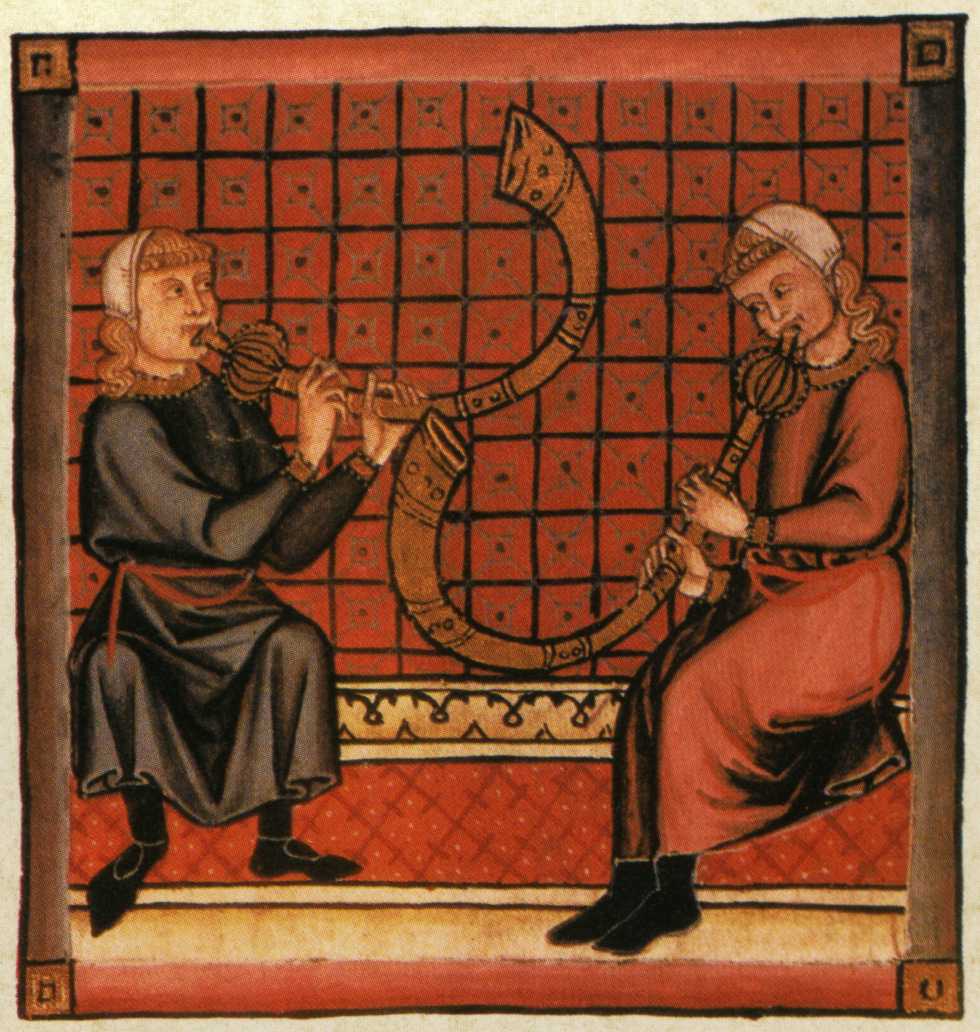
[two players of large wind instruments]]
Illustration of Cantiga 11 from the Cantigas de Santa Maria by Alphonsus X.

Rosa das Rosas: Cantigas de Santa Maria

The Newberry Consort

Jordan Hall

Thursday, June 13, 5 PM

MULTIMEDIA

This was billed as a multi-media event, which is a really good idea
for this music, because there are lots of people who have studied the
original 13th century manuscript in literature class or art class or
music class without any information about the rest of it.

There was a screen behind the performers which had a picture from the
manuscript, and translations of what the singers were singing. This
is really nicer for both audience and performers than everyone
squinting into their program books.

Many of the pictures have people playing instruments, and it was a
little jarring when the instrumentation chosen by the performers was
completely different from that in the pictures. I was particularly
struck during Cantiga 300, where the picture showed two
very conical bore wind instruments (not in enough detail to tell
whether they had a brass mouthpiece, a reed, or a fipple) and Tom
Zajac was playing a cylindrical bore traverse flute.

RECORDER and OTHER INSTRUMENTS

The music of the Cantigas is vocal, but to listen to an hour and
fifteen minutes without intermission, it was really nice that there
was a variety of instruments. There was vielle, rebec, lute, harp,
citole, hammered dulcimer, flute, recorder, bagpipe, and percussion.
(Played by 5 different people.)

Variety was also provided by supplementing the two singers (Ellen
Hargis and Matthew Dean) from the Newberry Consort with 5 singers from
the Boston area _a capella_ group Exultemus. So while Ellen Hargis
did the vast majority of the solo singing, dialogs could happen with
another singer, and some of the more general emotions could be
expressed with a choral sound. The final piece, Cantiga 10: Rosa das
Rosas, used this sound particularly well.

The recorder was actually on only one piece, but it was one of the
more striking uses of instrumental accompaniment. Cantiga 103 tells
the story of a monk who asks the Virgin to show him what the bliss of
heaven is like, and he starts listening to a bird sing, and the next
thing he knows it’s 300 years later and he no longer knows anyone in
the monastery. A highly improvised recorder solo (by Tom Zajac) was
the depiction of the bird song.

The other instrumentation I found most memorable was the quite simple
castanet beat (also played by Tom Zajac) with the Cantiga 425, about
the joy the disciples felt at the Resurection.

13th or 21st CENTURY?

The medieval notation used in the Cantigas is quite good at telling us
what notes comprise the tune, but experts differ by quite a bit about
the rhythms, and there aren’t harmonies or instrumentations notated
at all. So one is tempted to conclude that the good performers of
this music are actually quite good composers, and the music they’re
playing is twenty first century music, based on some material from the
thirteenth century.

This concert, partly because of the immersion in the pictures and the
ease of following the words, and also because of the relatively
“straight” interpretations, without a lot of composed harmony and
counterpoint, seemed more like a real experience from the 13th century
than other medieval concerts I have heard.


[Newberry Consort]
The Newberry Consort. (Left to Right): David Douglas, Ellen Hargis, Tom Zajac, Mark Rimple, Shira Kammen

Government Shutdown

I don’t know anyone who’s been killed by it yet.

One of the band memebers arrived yesterday saying that his SSI
payment wasn’t going to come. This isn’t what I get
from google,
but certainly even if he’s wrong, if lots of
people believe that, they’re probably pretty upset.

The other consequence I’ve heard of was in this
post
by Phil Greenspun. The short version is that because
the office he needed something from was only doing that ID, and
not all the other stuff they usually do, he got his ID much faster
than he normally would have.

I guess this probably shows that I live a pretty sheltered
life, at least on Tuesdays. And of course my not knowing about
any serious short-term consequence doesn’t mean that there aren’t
some, and certainly doesn’t mean there won’t be serious long-term
consequences.

And it also doesn’t mean that I agree with a system that allows
one man to single-handedly shut down the government. (I know the
House Republicans who elected John Boehner as speaker, and could
presumably elect someone else if they didn’t like what he’s doing,
share the blame, but really it wouldn’t be happening if he hadn’t
decided he wanted it, and it will stop as soon as he decides to
stop it.)

My trip to the museum

[Turner Slave Ship]
Slave Ship (Slavers Throwing Overboard the Dead and Dying, Typhoon Coming On) by J.M.W. Turner (1775–1851)

I went to the Boston Museum of
Fine Arts
on Saturday.

I was going to write a deep essay, but it would take too much
time, so here are some random observations:

  • The flow of the European painting galleries is currently
    very confusing. You walk out of the 14th century chapel into
    19th century French art. There used to be a fairly logical
    progression from Medieval to almost-twentieth-century art, but
    if there’s any logic to it now, I couldn’t find it.
  • There was a similar problem downstairs in the Art of the
    Americas gallery — we were in the American Revolution, and then
    all of a sudden we were in Peru, and then we were in early
    nineteenth-century Boston. If there were rooms about other
    places in South America, I never found them.
  • I did manage to find the Turner Slave
    Ship
    . I don’t think I’ve ever been in the presence of any
    work of art that’s so immediately affecting. I have seen the
    Mona Lisa and the Pieta, but this is
    just hanging there on the wall and you can walk right up to it.
    It is listed in the brochure as one of the 12 greatest hits, but
    otherwise it’s treated just like any other picture.
  • The Rembrandt etchings were interesting, but to really see
    them, you’d need better light and a magnifying glass.
  • The other current exhibition I enjoyed was the Loïs
    Mailou Jones
    one. My favorite of her works was a painting
    called My Mother’s Hats — her mother was a
    successful milliner.
  • The most memorable new-to-me work I saw was a Japanese print
    of a daemon who committed suicide after flunking the civil
    service exam. It’s in red.
  • You shouldn’t even try to see everything in one afternoon —
    we should have left and hung out in the pub across the street
    about an hour before we did.

My sister, who bought the tickets, got an email request to fill
out a particularly annoying survey about her experience. For
instance, they asked what the purpose of the visit was, and “To
see the art” wasn’t one of the choices:

Which of the following statements best describes your reason for 
visiting the MFA? *This question is required. 

* I went to see a specific exhibit and/or learn about a specific 
  topic

* I went to have a new experience and just follow whatever sparked
  my curiosity and interest

* I came to spend time with friends and/or family and help them have
  a meaningful experience at the MFA

* I went to attend a specific program, lecture, course, concert,
  class, and/or film

* I like to seek out interesting things to do and the MFA is
  considered an important institution in Boston

* I went to relax in a peaceful setting and contemplate the art 
  and/or myself