The Boston Musical Intelligencer reviews the Sunday opera performance.
Category: concerts
Review of Il ritorno d’Ulisse in patria
Fuse has published a review of the first BEMF opera performance.
Looking forward to BEMF 2015
This is the start of the fifth biennial “Blogging from BEMF”
event.
As in previous years, the actual blogging during the week will
be erratic. Blogging isn’t really compatible with going to
concerts at all hours of the day and night, and I really couldn’t
report on what’s happening if I didn’t do that.
Also, I have several comp tickets in return for writing up
events for the American
Recorder Magazine. So I won’t post in great detail about
those events at least until after the magazine has appeared.
But as usual, I will try to point to any interesting coverage,
and follow the exhibition and some of the fringe events better
than the mainstream press does.
Festival Concerts
In addition to their usual paucity of reed and brass playing,
this year there’s very little renaissance music at all in the main
concerts. So I have:
- Jordi
Savall doing music from Mexico and South America, in addition to Spanish
Renaissance composers Diego Ortiz and Pedro Guerrero. (Monday
evening concert.) - Monteverdi’s
Vespers of 1610, which my college music history courses
considered as the beginning of the Baroque, but a lot of the
solo playing is still very like what they did in the
renaissance. (Thursday evening concert.) - Norbert
Rodenkirchen playing medieval flutes. (Thursday 11pm concert.) - Musica
Pacifica on the grounds that I often like hearing
what professional concert musicians do with dance music. (Or
if not, I like figuring out why not and criticizing it.) (Friday
11pm concert.) - Orfeo.
This is the one of the three operas that has the wind band, so
it’s the one I got. (Saturday evening opera) - Inventions of
Delight: Dance music from the courts of the early 17th
century. See above; also this concert will include the wind
ensemble that’s playing the Vespers and Orfeo. Also, the
Saturday 11pm concert is very consistently enjoyable and high
4 energy. These are the people who’ve been playing together all
week in the opera orchestra, and it’s almost over, and they get
to do what they have fun with. (Saturday 11pm concert.) - Michael
Form and Friends. The last few years, they’ve gotten a good
recorder soloist or group to do the Sunday afternoon concert,
and to teach a masterclass on Saturday. So this is where to go
to hobnob with all the other recorder players.
Masterclasses
You should check out the Masterclass
for any instrument you’re particularly interested in. Even if the
eminent performer who teaches it doesn’t turn out to have anything
interesting to say (rare in my experience), you’ll get to see some
of the up-and-coming young players and what they’re working
on.
I’ll be going to the Saturday 11am recorder masterclass with
Michael Form. If schedule permits, I’d like to get to the lute
song one on Saturday at 4:30 with Ellen Hargis, Paul Odette and Stephen Stubbs. They
do it every festival, and I’ve always enjoyed it when I’ve been
able to go.
Exhibition
Long-time readers of this blog will of course not be under the
common misapprehension that BEMF is about holding concerts by major
recording artists and selling their CD’s.
Like other long-time institutions of the early music
movement, BEMF is built on the collaboration between professional
performers, instrument makers, musicologists, and the amateur
performers who are the most enthusiastic supporters of (and providers
of income stream to) the other pillars of the movement.
And the best place at BEMF to appreciate this is to go to the
exhibition.
This year’s List of
Exhibitors looks unusually interesting, with Adriana Breukink, an
innovative recorder maker, Leslie Ross, who makes
bassoons and dulcians, and Turners’ Quay who do
clarinets and cornetti.
Fringe Concerts
Here are some of the fringe concerts I want to call attention
to. Please note that failing to mention someone here doesn’t
mean I don’t think it will be a good concert. I’m mainly
mentioning the ones I mention either because they’re doing
Renaissance music or because I know them personally.
- Friends of Tom Zajac, 6pm, Monday, First Lutheran Church.
Tom is a very well liked player and coach of recorders, sackbut,
bagpipes, percussion, and probably other things. He has been
having recurring medical problems. Insurance takes care of the
medical bills, but not the lost income when he can’t work. So a
bunch of his friends, also very fine players, have organized a
benefit concert. - Renaissonics, Noon, Tuesday, Brown Hall, New England
Conservatory. Some of the cornerstones of Renaissance music
were improvisation and dance music, and Renaissonics does this
better than most currently active groups. - Long and Away, noon, Wednesday, Hunnewell Chapel at
Arlington Street Church. Songs from the Spanish Netherlands
written between 1568 and 1648. - The Duke Vespers Ensemble et al., 1:30pm, Wednesday, Church
of the Covenant. Seventeenth century Roman
Church music on a variety of instruments including brass. - Judith Conrad on triple-fretted clavichord, 2pm, Wednesday,
Paulist Center Library. Music of Samuel Scheidt published in
1628. - Jean Maillard Singers, 3pm, Thursday, Beacon Hill Friends
House. Music of Jean Maillard (c. 1515 – after 1570). - Recorder Relay, 9:15am Friday, Church of Saint John the
Evangelist. I’m particularly looking forward to the last group,
scheduled for 11:20,
which is several of the local professional recorder players
playing Renaissance music on matched Renaissance recorders. - Convivium Musicum, Saturday, noon, First Lutheran Church.
Their Sweelinck concert drew rave reviews when they sang it last
Spring. - Vox Lucens, 4:30pm, Saturday, Goethe Institute.
Ancient Greek Music
![[Greek Musicians]](https://i0.wp.com/i.dailymail.co.uk/i/pix/2013/10/28/article-2478381-190A754F00000578-7_634x318.jpg)
This
article is about a scholar who claims to be able to decode an
ancient greek music notation. I can’t tell from the article what
he really did, but you will enjoy listening to the recreation of
the music.
The Newberry Consort at BEMF
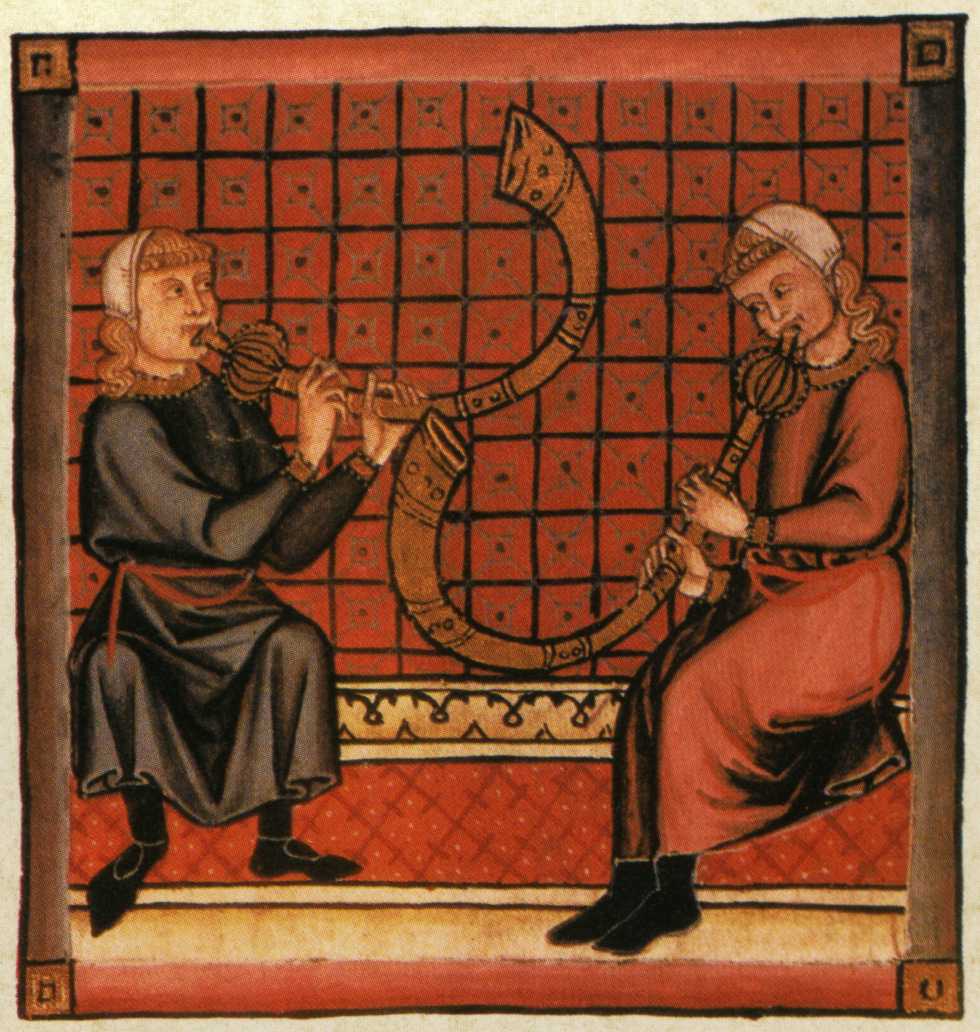
![[two players of large wind instruments]]](https://i0.wp.com/www.pbm.com/~lindahl/cantigas/images/cantiga_11.jpg)
Rosa das Rosas: Cantigas de Santa Maria
The Newberry Consort
Jordan Hall
Thursday, June 13, 5 PM
MULTIMEDIA
This was billed as a multi-media event, which is a really good idea
for this music, because there are lots of people who have studied the
original 13th century manuscript in literature class or art class or
music class without any information about the rest of it.
There was a screen behind the performers which had a picture from the
manuscript, and translations of what the singers were singing. This
is really nicer for both audience and performers than everyone
squinting into their program books.
Many of the pictures have people playing instruments, and it was a
little jarring when the instrumentation chosen by the performers was
completely different from that in the pictures. I was particularly
struck during Cantiga 300, where the picture showed two
very conical bore wind instruments (not in enough detail to tell
whether they had a brass mouthpiece, a reed, or a fipple) and Tom
Zajac was playing a cylindrical bore traverse flute.
RECORDER and OTHER INSTRUMENTS
The music of the Cantigas is vocal, but to listen to an hour and
fifteen minutes without intermission, it was really nice that there
was a variety of instruments. There was vielle, rebec, lute, harp,
citole, hammered dulcimer, flute, recorder, bagpipe, and percussion.
(Played by 5 different people.)
Variety was also provided by supplementing the two singers (Ellen
Hargis and Matthew Dean) from the Newberry Consort with 5 singers from
the Boston area _a capella_ group Exultemus. So while Ellen Hargis
did the vast majority of the solo singing, dialogs could happen with
another singer, and some of the more general emotions could be
expressed with a choral sound. The final piece, Cantiga 10: Rosa das
Rosas, used this sound particularly well.
The recorder was actually on only one piece, but it was one of the
more striking uses of instrumental accompaniment. Cantiga 103 tells
the story of a monk who asks the Virgin to show him what the bliss of
heaven is like, and he starts listening to a bird sing, and the next
thing he knows it’s 300 years later and he no longer knows anyone in
the monastery. A highly improvised recorder solo (by Tom Zajac) was
the depiction of the bird song.
The other instrumentation I found most memorable was the quite simple
castanet beat (also played by Tom Zajac) with the Cantiga 425, about
the joy the disciples felt at the Resurection.
13th or 21st CENTURY?
The medieval notation used in the Cantigas is quite good at telling us
what notes comprise the tune, but experts differ by quite a bit about
the rhythms, and there aren’t harmonies or instrumentations notated
at all. So one is tempted to conclude that the good performers of
this music are actually quite good composers, and the music they’re
playing is twenty first century music, based on some material from the
thirteenth century.
This concert, partly because of the immersion in the pictures and the
ease of following the words, and also because of the relatively
“straight” interpretations, without a lot of composed harmony and
counterpoint, seemed more like a real experience from the 13th century
than other medieval concerts I have heard.
![[Newberry Consort]](https://i0.wp.com/66.147.244.148/~classjn4/wp-content/uploads/2013/07/The-Newberry-Consort-courtesy-BEMF.jpg)
The New York Continuo Collective
Continuing to bring you my reporting from the 2013 Boston Early Music Festival. The
American Recorder editor cut this one
even worse than most of what I sent her, because it wasn’t really
a recorder concert at all.
The New York Continuo Collective
L’amour et La Folie
Love and Madness in the Air de Cour
Thursday, June 13, 2013, Noon
Gordon Chapel, Old South Church
645 Boylston ST., Boston
The New York Continuo Collective is mostly a bunch of plucked string
players accompanying singers. There’s one bass viol (Virginia
Kaycoff), and they get instrumental solos (aside from lutes playing the
tunes) by having a couple of people play recorders (Grant Herreid and Paul
Shipper).
Every “semester” they study a different repertory of 17th century
song, and this Spring it was the French Air de Cour. The program was
based around a collection of songs with lute tablature published in
1614 by Gabriel Bataille, which seem to be from a ballet depicting a
quarrel between Amour and La Folie.
The program was semi-staged and variously costumed — some characters
only wearing a hat to indicate their character, but Venus (Kirsten
Kane) wearing a golden gown that was definitely not street wear. La
Folie (Brittany Fowler) wore street wear, but mixed patterns and
stripes in a charmingly disturbing way.
The plot involved Amour attempting to prove that he enhances human
happiness, in the face of La Folie’s claim that love only leads to
misery. So there are lots of songs sung by characters labeled
“quarreling lovers”, “rude lover”, or “angry lover”. So with the
dance interludes and the various moods of the lovers, it was a very
diverse program. The ornamentation, both improvised and written out
by the director (Grant Herried) also added variety.
One of the problems of running an early music group in contemporary
American musical culture is that the guitar and lute players often
become very skilled on their instruments without getting the ensemble
experience that wind and bowed string instrument players have
routinely. The Continuo Collective is a brilliant response to this
problem, while also producing a very enjoyable show.
Monday at BEMF 2013
I promised you some of what I should have been blogging at the
The Boston Early Music Festival.
The easy way to do this is to give you what I actually wrote not
too long afterwards, but didn’t blog because I was writing it for
a magazine (the
magazine of The American Recorder Society). Now that the magazine has come out, and a large part
of what I wrote has been edited out for length, I don’t see
anything wrong with giving it to you.
The first article was about two fringe concerts on Monday, June
10.
Ensemble 1729
Ensemble 1729: Il Proteo o sià il Mondo al Rovascio
Italian and German Chamber Concertos
10 June, 2013 at 16:00
First Lutheran Church
299 Berkeley St., Boston
Because I live in the Boston area, the editor of this magazine often
asks me to review several concerts early in the Boston Early Music
Festival, because a lot of her out-of-town reviewers haven’t arrived
yet. At the last festival, I saw two local groups at the top of their
game on Monday afternoon.
This year, I got a crash course in the perils of rolling into town on
Sunday and playing a concert on Monday afternoon, even for superb
musicians with decades of experience playing concerts.
Ensemble 1729 is a group of young musicians who met while studying at
McGill University in Montreal. Their publicity emphasizes their
“stylish wit, sensitivity, and quicksilver changes of mood and
color”. Their program started with the Vivaldi concerto which gave
the concert its name. The whole group, consisting of two
harpsichords, recorder (Vincent Lauzer), traverso and string quartet,
was playing. Vivaldi displays the mutability of Proteus by shifting
the tune between all voices, and the different textures certainly made
for an interesting set of sounds.
The middle of the concert was taken up with two pieces (Pasquini
Sonata #10 in c minor for two bassi continue, and Bach Concerto in C
major for two harpsichords) for two harpsichords. This was
problematic for this reviewer, seated at about the middle of the hall,
because the similar sounding harpsichords were nested at center stage, and there was no
way I could tell which harpsichord was playing which notes. People
closer to the front, or even off to one side, had less of a problem
with this, but for me, the dueling improvisations of the Pasquini were
completely lost.
The First Lutheran Church is beloved of _a capella_ vocal groups
because the high, vaulted ceiling takes the sound and bounces it
around until it sounds blended even if the voices are not in fact as
even as one might wish. Unfortunately, this isn’t really what you
want for chamber music.
The concert concluded with the Telemann Concerto in e minor for
recorder and flute. This wasn’t as problematic as the two
harpsichords, because the flute and the recorder do have different
timbres, and you could see which was playing in solo passages. But
other times I’ve seen this concerto performed, but soloists were at
oppposite side of the stage, where here the two wind players stood
next to each other, giving no stereo separation between the sounds.
I was relieved, however, that where most of the concert seemed to have
been aiming for “stylish and elegant”, the final presto of the
Telemann was performed as though the people dancing it might have had
boots on.
Der Getreue Music-Meister
Masters of German baroque music
Performed by the Early Music faculty of the University of North Texas
Monday, June 10, 2013, 6:30 pm
Church of the Covenant
67 Newbury St., Boston
The University of North Texas faculty weren’t making any rookie
mistakes about placement of the performers. And Paul Leenhouts’
recorder playing took aggressive advantage of the recorder’s wider
range of articulations than the oboe (played by Kathryn Montoya) in
the Telemann Concerto in G major (TWV 43-G6). So I was surprised when
Paul made the announcement that Petra Somlai wasn’t going to play her
planned Haydn Sonata, because the harpsichord was missing keys on both
the top and the bottom. It was also small for the large church it was
playing in. As a continuo instrument, it was fine when it was being
supported by the cello (Allen Whear), but seemed more like background
music when it was playing solo, obviously with the cello sonata
(Telemann Sonata in D major, TWV41:D6), but also in a violin sonata
(Bach, BWV 1017, played by Cynthia Roberts).
The rest of the concert (a solo oboe Sonata by Kirnbirger and a Trio
sonata for recorder and violin by Telemann) was admirable baroque
chamber music, with continuo driving the rhythm while the soloists
produce beautiful lines.
Early Music America reviews Boston Early Music Festival
I promised you more about BEMF, and some of what I want to
say will take place over several posts. But I got the Fall Early
Music America, and thought I’d comment on their reviews.
The fringe concerts are numerous, diverse, and crammed into a
small number of time slots when there aren’t official events, so
it isn’t that surprising that the EMA reviewers didn’t review any
of the ones I went to. But they at least mentioned all of the
“main stage” events.
I like the idea of 11 PM concerts, but in practice,
unless they’re very lively indeed, I often find myself falling
asleep, especially later in the week, which is strenuous for me.
So although I expected them to be good concerts, I didn’t go to
the Wednesday night lute concert (EMA: soothed an audience
of insomniacs) or the Thursday night
Atalanta concert. I did as usual enjoy the Saturday
night Tragicommedia concert of German drinking
songs. But I would have been just as well off skipping the gaelic
song and harp music concert on Friday.
I agree that the Newberry Consort multimedia presentation of
the Cantigas de Santa Maria was one of the
highlights of the festival, and I’ll probably give you some more
about that later.
EMA calls Emma Kirkby’s Dowland performance “transcendant”, and
I agree with that. I was worried about going to a concert of lute
songs in a space as big as Jordan Hall, but it wasn’t a problem at
all, even though my friends and I decided to stay in the nosebleed
seats where my lingering cough wouldn’t disturb as many people.
(There’s also more leg room there — I don’t know why those seats
aren’t sold to the long-legged at a premium.)
EMA says “The Hilliard Ensemble brought an
admirable transparency and lucidity to a remarkably diverse
repertoire.” I liked the lucidity, but I would have prefered a
real program to the “greatest hits” approach they took. I liked
all the sixteenth century music better than
all the other stuff, so I’d rather they’d just played
that.
The Royal Wind Music concert did, as EMA reports,
blow the audience away, but I share the reservations of David
Schulenberg in the Boston Musical Intelligencer that they made
a verbatim copy of what was on their CD in a repertoire that was
intended to be improvised.
New York Times writes about Mozart’s instruments
In this article, the New York Times provides more information about the heavily advertised appearance of Mozart’s violin and viola at the 2013 Boston Early Music Festival. There will be a concert on both the violin and viola (joined by fortepiano and clarinet), and the instruments will be on view at the exhibition on Wednesday morning.
Apparently Mozart never performed publicly on the violin, and this instrument was left behind in Salzburg when he moved to Vienna. He did like playing viola, and this instrument was owned by his widow after his death.
Serpents at BEMF 13

I got an email this morning from Pierre Ribo:
Let me introduce myself. My name is Pierre Ribo and I am a serpent
maker in Brussels, Belgium.I will be present at the Boston Early Music Festival from June 12th
until the 15th to present four of my serpents (with four keys and 6
holes church serpent).My purpose is to propose my instruments in the USA and also to meet
musicians, since their reactions are very important to me.I would be pleased to meet you during my stay in Boston, if possible
for you.In case you would know other musicians interested in the serpent, may
I ask you to forward this mail or spread the word around you?
The official concert schedule is as much of an early brass wasteland
as ever, but it looks like there will at least be a few serpents at
the exhibition.
 LayMusic.org