I moved the toaster

[counter]

I just rearranged the appliances on the counters.

One problem with my kitchen is that there’s a counter that goes
around a corner, leaving a black hole both in the cabinets and on
the countertop that’s a lot less useful than you’d like it to
be.

I thought that would be a good place for the microwave oven,
but there’s no way to work without taking up the space that the
oven door would need to open there, so instead I have the microwave on
the counter between the fire escape door and the dining room
window. This makes that counter, which you need to use for
loading and unloading the refrigerator, a lot smaller than you’d
like.

I’m not currently using the toaster as often as I have in the
past, both because of my greens for
breakfast
discovery, and because a good bakery opened up down
the street, so I sometimes go buy croissants when I would have
formerly made toast.

So my current idea is that the dead area in the corner is used
for small appliances that are used often but not daily, and is
flanked by the knife rack which is still a bit improvised but
doesn’t fall apart too often as long as you don’t try to use the
giant chef’s knife, which I only use for cutting pizza. It’s a
franken-knife rack — I combined the magnetic strip I never
managed to affix to anything with the rack of vertical slots which
I snarfed from Bonnie’s kitchen. On the
other side, the smaller appliances are held in place by the slow
cooker/rice cooker/pressure cooker, which is used several times a
week.

Right now the toaster, the stick blender, and the hand mixer
live there. I’ve been sharpening the knives on the arkansas
stone, so the knife sharpener went into the appliance cabinet,
along with the waffle iron which I haven’t used very often since I
bought it.

This makes the appliance cabinet more crowded than it should
be. The obvious thing to do about that is to discard or donate
the bread machine, which has seen better days, but I’ve been
trying to decide whether

[microwave]

Obviously one of the advantages to doing something like this is
that you move everything out and clean under it. (I cheated and
didn’t do the microwave, yet.) So some spiders crawled out and
were very annoyed at me, but I assured them I wasn’t going to be
doing this every week. I pointed out that there were some
housekeepers who do something like it every day, and they wouldn’t
want to live there at all.


[spider]

Report on the week of September 30, 2013

We played:

Schedule

Next week, October 8, we will deviate from our usual format.
Some people want to go see Marilyn Horne teach a masterclass in
Jordan Hall at 7 PM. Other people will be rehearsing for the
Harvard Square English Country Dance at 7:45 pm at my place. The
Masterclass is free and open to the public. The Country Dance
rehearsal is open to anyone who likes playing English Country
Dance music, but one assumes that if you want to play it on
Tuesday, you would also like to play the
actual dance on
Friday, October 11 at Harvard-Epworth Church.

That link has a
list of the tunes we will be working on. They’re all in Barnes (I
or II); let me know in advance if you’re coming and won’t be able to bring your books.

After that we will resume our usual schedule, meeting on
Tuesdays at 7:45 at my place.

Other Playing Opportunity

I think I haven’t pushed the West Gallery Quire
lately — if you sing or play a melody instrument, you should try
it out. Sunday, October 13, will be a particularly good day to do
that,
since Sheila and Edwin Macadam, two of the leaders of the West
Gallery rediscovery, will be leading the group.

Other partying opportunities

If you vote in Cambridge, I’m having a get-together at 7pm on Wednesday, October 9 for City
Council candidate Dennis Carlone.

The Boston Wort Processors
will be having their annual cider picnic on Sunday, October 20 at
noon. Let me know if you’d be interested in going and maybe doing
some playing. It’s in Amesbury, so we’d probably want to
carpool.

A note on this week’s transcriptions

Xavier Verhelst, who did a lot of transcription for the edition
of Ortiz
that John Tyson and I did,
sent me the edition he’s done recently of Constanze Festa’s
Il Primo Libro de Madrigale. His editions are done
with Sibelius (which I can’t read), and don’t have barlines, but do
come as a score, so to use it in our group, I used a web service
called Partifi to get the
individual parts.

If we end up working on some of them, I will probably
transcribe them in our usual format, but for running through them
to see if we like them, this is good.

The Newberry Consort at BEMF

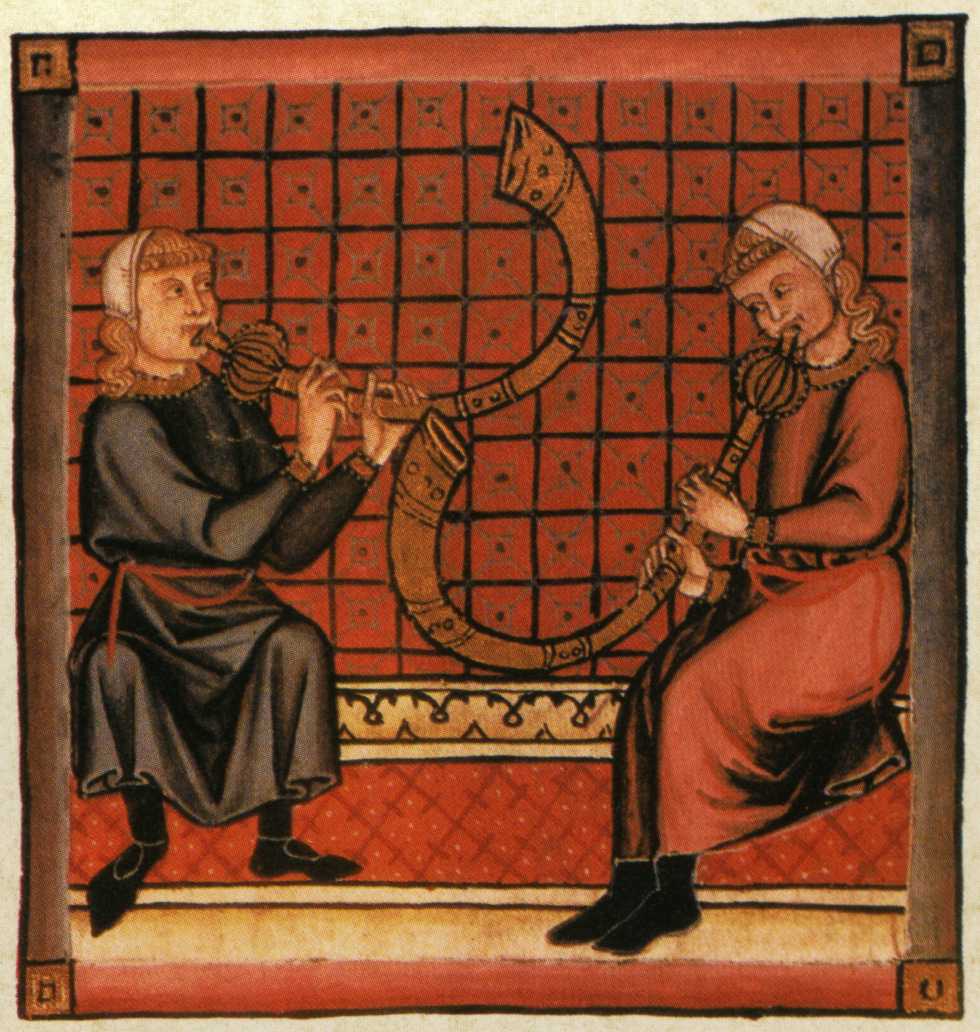
[two players of large wind instruments]]
Illustration of Cantiga 11 from the Cantigas de Santa Maria by Alphonsus X.

Rosa das Rosas: Cantigas de Santa Maria

The Newberry Consort

Jordan Hall

Thursday, June 13, 5 PM

MULTIMEDIA

This was billed as a multi-media event, which is a really good idea
for this music, because there are lots of people who have studied the
original 13th century manuscript in literature class or art class or
music class without any information about the rest of it.

There was a screen behind the performers which had a picture from the
manuscript, and translations of what the singers were singing. This
is really nicer for both audience and performers than everyone
squinting into their program books.

Many of the pictures have people playing instruments, and it was a
little jarring when the instrumentation chosen by the performers was
completely different from that in the pictures. I was particularly
struck during Cantiga 300, where the picture showed two
very conical bore wind instruments (not in enough detail to tell
whether they had a brass mouthpiece, a reed, or a fipple) and Tom
Zajac was playing a cylindrical bore traverse flute.

RECORDER and OTHER INSTRUMENTS

The music of the Cantigas is vocal, but to listen to an hour and
fifteen minutes without intermission, it was really nice that there
was a variety of instruments. There was vielle, rebec, lute, harp,
citole, hammered dulcimer, flute, recorder, bagpipe, and percussion.
(Played by 5 different people.)

Variety was also provided by supplementing the two singers (Ellen
Hargis and Matthew Dean) from the Newberry Consort with 5 singers from
the Boston area _a capella_ group Exultemus. So while Ellen Hargis
did the vast majority of the solo singing, dialogs could happen with
another singer, and some of the more general emotions could be
expressed with a choral sound. The final piece, Cantiga 10: Rosa das
Rosas, used this sound particularly well.

The recorder was actually on only one piece, but it was one of the
more striking uses of instrumental accompaniment. Cantiga 103 tells
the story of a monk who asks the Virgin to show him what the bliss of
heaven is like, and he starts listening to a bird sing, and the next
thing he knows it’s 300 years later and he no longer knows anyone in
the monastery. A highly improvised recorder solo (by Tom Zajac) was
the depiction of the bird song.

The other instrumentation I found most memorable was the quite simple
castanet beat (also played by Tom Zajac) with the Cantiga 425, about
the joy the disciples felt at the Resurection.

13th or 21st CENTURY?

The medieval notation used in the Cantigas is quite good at telling us
what notes comprise the tune, but experts differ by quite a bit about
the rhythms, and there aren’t harmonies or instrumentations notated
at all. So one is tempted to conclude that the good performers of
this music are actually quite good composers, and the music they’re
playing is twenty first century music, based on some material from the
thirteenth century.

This concert, partly because of the immersion in the pictures and the
ease of following the words, and also because of the relatively
“straight” interpretations, without a lot of composed harmony and
counterpoint, seemed more like a real experience from the 13th century
than other medieval concerts I have heard.


[Newberry Consort]
The Newberry Consort. (Left to Right): David Douglas, Ellen Hargis, Tom Zajac, Mark Rimple, Shira Kammen

Government Shutdown

I don’t know anyone who’s been killed by it yet.

One of the band memebers arrived yesterday saying that his SSI
payment wasn’t going to come. This isn’t what I get
from google,
but certainly even if he’s wrong, if lots of
people believe that, they’re probably pretty upset.

The other consequence I’ve heard of was in this
post
by Phil Greenspun. The short version is that because
the office he needed something from was only doing that ID, and
not all the other stuff they usually do, he got his ID much faster
than he normally would have.

I guess this probably shows that I live a pretty sheltered
life, at least on Tuesdays. And of course my not knowing about
any serious short-term consequence doesn’t mean that there aren’t
some, and certainly doesn’t mean there won’t be serious long-term
consequences.

And it also doesn’t mean that I agree with a system that allows
one man to single-handedly shut down the government. (I know the
House Republicans who elected John Boehner as speaker, and could
presumably elect someone else if they didn’t like what he’s doing,
share the blame, but really it wouldn’t be happening if he hadn’t
decided he wanted it, and it will stop as soon as he decides to
stop it.)

Partifi

Somebody told me about partifi
a year or two ago. It takes a PDF file with a musical score in
it, and turns the score into parts. Even if your religion doesn’t
forbid you to play Renaissance music from scores, you must have
run into a score with a page turn every 5 seconds that drove you
nuts, so this sounds like a really good idea.

At the time I heard of it, I went there and tried something and
the first thing I tried wasn’t immediately useful, so while I’ve
passed the word on to several people who were complaining about
page turns, I haven’t actually used it for anything.

But yesterday a music transcribing friend sent me a PDF of some
three part madrigals he’s been working on. He leaves out the
barlines, but puts the parts into score, so I thought about asking
him to send me the source or MIDI so that I could do parts, but
then I remembered Partifi.

I fed it three PDF’s, and the first two went very smoothly. It
guessed quite well at where on the page to split out the parts. I
told it the names of the parts and it produced three part files
for me.

The third one had to be set with the lines much closer together
in order to fit the whole piece on two pages. So partifi’s guess
about how to split the parts was much less useful, and even when I
figured out how to edit the guess, I still ended up with parts
missing words. I think I have an idea of how to fix this, but I
wanted to get the post done before fiddling with it any more.

My trip to the museum

[Turner Slave Ship]
Slave Ship (Slavers Throwing Overboard the Dead and Dying, Typhoon Coming On) by J.M.W. Turner (1775–1851)

I went to the Boston Museum of
Fine Arts
on Saturday.

I was going to write a deep essay, but it would take too much
time, so here are some random observations:

  • The flow of the European painting galleries is currently
    very confusing. You walk out of the 14th century chapel into
    19th century French art. There used to be a fairly logical
    progression from Medieval to almost-twentieth-century art, but
    if there’s any logic to it now, I couldn’t find it.
  • There was a similar problem downstairs in the Art of the
    Americas gallery — we were in the American Revolution, and then
    all of a sudden we were in Peru, and then we were in early
    nineteenth-century Boston. If there were rooms about other
    places in South America, I never found them.
  • I did manage to find the Turner Slave
    Ship
    . I don’t think I’ve ever been in the presence of any
    work of art that’s so immediately affecting. I have seen the
    Mona Lisa and the Pieta, but this is
    just hanging there on the wall and you can walk right up to it.
    It is listed in the brochure as one of the 12 greatest hits, but
    otherwise it’s treated just like any other picture.
  • The Rembrandt etchings were interesting, but to really see
    them, you’d need better light and a magnifying glass.
  • The other current exhibition I enjoyed was the Loïs
    Mailou Jones
    one. My favorite of her works was a painting
    called My Mother’s Hats — her mother was a
    successful milliner.
  • The most memorable new-to-me work I saw was a Japanese print
    of a daemon who committed suicide after flunking the civil
    service exam. It’s in red.
  • You shouldn’t even try to see everything in one afternoon —
    we should have left and hung out in the pub across the street
    about an hour before we did.

My sister, who bought the tickets, got an email request to fill
out a particularly annoying survey about her experience. For
instance, they asked what the purpose of the visit was, and “To
see the art” wasn’t one of the choices:

Which of the following statements best describes your reason for 
visiting the MFA? *This question is required. 

* I went to see a specific exhibit and/or learn about a specific 
  topic

* I went to have a new experience and just follow whatever sparked
  my curiosity and interest

* I came to spend time with friends and/or family and help them have
  a meaningful experience at the MFA

* I went to attend a specific program, lecture, course, concert,
  class, and/or film

* I like to seek out interesting things to do and the MFA is
  considered an important institution in Boston

* I went to relax in a peaceful setting and contemplate the art 
  and/or myself

A limerick

I don’t write them very often — the one I
like best
I posted here in 2005. But Garrison Keeler was on
the radio yesterday, and he pointed out that when he discovers a
rhyme it makes his brain light up and he needs to do something
with it, and I realized I used to be that way but I let it lapse.
So I swore that the next time I discovered a rhyme, I would write
a limerick. So I noticed one walking the dog this morning and
here’s the limerick:

Priscilla, a grey furry rat,
Had friends who thought she was too fat.
    So she ran down the street
    And tripped over her feet
And ended up totally flat.

Flat and rat isn’t a great rhyme like the ones Ira Gershwin and
Cole Porter used, but limericks don’t need a lot more than that.
I had rat and fat and street and feet by the time I got home.

My first reaction to the flat rat on Cherry Street was,
“Another flat squirrel!” because we’d seen one of those on Windsor
Street last night, but then I noticed the tail, and then I had the
rhyme.

Candidate meet-and-greet at my house

Teaparty

Two current Cambridge city councillors aren’t running for
re-election, so it’s a wild and crazy race this year. 25
candidates are running for 9 seats.

I usually like to find someone good who’s new to support, and
this year I’ve picked Dennis Carlone, based on the
recommendation of a couple of people who are currently active in
my neighborhood association. He’s an architect and urban planner,
and will bring a level of expertise about development and zoning
issues to the council that is currently missing. My friends also
tell me that he’s been superb in negotiations with developers even
after we’ve lost on the zoning issues in getting them to make
their designs more livable.

So I wrote his campaign a small check, and then we were talking
about what else I could do. I don’t usually put up signs, because
I live in a condo. One time another resident put up a sign for
the Libertarian candidate, and I was really annoyed at him.

But I like throwing parties, so I said I’d invite all my
friends and neighbors to come meet Dennis at my house, and we
settled on Calzones with Carlone on Wednesday,
October 9, at 7:00 PM at 233 Broadway.

If you vote in Cambridge, you’re welcome to come, meet people,
have some good food, and hear what Dennis has to say about what he
can bring to the city council.

Here’s an invitation
that you can print out and give to your friends.


carlone

The New York Continuo Collective

Continuing to bring you my reporting from the 2013 Boston Early Music Festival. The
American Recorder editor cut this one
even worse than most of what I sent her, because it wasn’t really
a recorder concert at all.

The New York Continuo Collective

L’amour et La Folie

Love and Madness in the Air de Cour

Thursday, June 13, 2013, Noon

Gordon Chapel, Old South Church

645 Boylston ST., Boston

The New York Continuo Collective is mostly a bunch of plucked string
players accompanying singers. There’s one bass viol (Virginia
Kaycoff), and they get instrumental solos (aside from lutes playing the
tunes) by having a couple of people play recorders (Grant Herreid and Paul
Shipper).

Every “semester” they study a different repertory of 17th century
song, and this Spring it was the French Air de Cour. The program was
based around a collection of songs with lute tablature published in
1614 by Gabriel Bataille, which seem to be from a ballet depicting a
quarrel between Amour and La Folie.

The program was semi-staged and variously costumed — some characters
only wearing a hat to indicate their character, but Venus (Kirsten
Kane) wearing a golden gown that was definitely not street wear. La
Folie (Brittany Fowler) wore street wear, but mixed patterns and
stripes in a charmingly disturbing way.

The plot involved Amour attempting to prove that he enhances human
happiness, in the face of La Folie’s claim that love only leads to
misery. So there are lots of songs sung by characters labeled
“quarreling lovers”, “rude lover”, or “angry lover”. So with the
dance interludes and the various moods of the lovers, it was a very
diverse program. The ornamentation, both improvised and written out
by the director (Grant Herried) also added variety.

One of the problems of running an early music group in contemporary
American musical culture is that the guitar and lute players often
become very skilled on their instruments without getting the ensemble
experience that wind and bowed string instrument players have
routinely. The Continuo Collective is a brilliant response to this
problem, while also producing a very enjoyable show.